
Help for a smile
Für Kinder in Afrika
Help for a smile
Für Kinder in Afrika


Our Project
HELP FOR A SMILE e.V. supports Irene in Uganda as well as 16 children and young people, aged 8 to 21, whose parents are either deceased or in prison. The association helps ensure that these children receive adequate nutrition, schooling, and medical care. Our goal is to provide the children with hope, a new home, and the opportunity for a better future.
Bettina first met extraordinary people like Irene—who volunteers her time to care for disadvantaged children—during her voluntary service in Uganda in 2010 while working in orphanages and schools.
Irene cares for orphans and children who have been left behind because their parents are incarcerated long-term or because the remaining parent has abandoned them. During school holidays, these children live with Irene in the small village of Natondome, near the city of Mbale in eastern Uganda. Irene provides food, water, and school fees, while giving the children the love and attention they deserve.
In recent years, thanks to generous individual donations beyond basic care and school fees, we have been able to provide new beds and furniture. Furthermore, water pipes were laid, water tanks purchased, a solar power system installed, and structural expansions completed to ensure sufficient sleeping quarters and sanitary facilities for our growing number of protégés.
To provide the children and youth with the best possible education, they attend boarding school. Irene organizes school attendance for all 16 individuals, visits them on weekends, is available for questions at any time, and brings the children home if they fall ill. During the holidays, when all the children are with Irene, various leisure activities and learning projects are offered. Irene also engages in village projects to support as many mothers and children as possible, contributing to the wider community. This includes educational projects for children and their mothers, which we as an association are proud to support.
Through this project, we contribute to seven of the 17 Sustainable Development Goals (SDGs) adopted by the United Nations. These goals serve as central indicators through 2030 to ensure the socially, economically, and ecologically sustainable development of our planet.
About Uganda
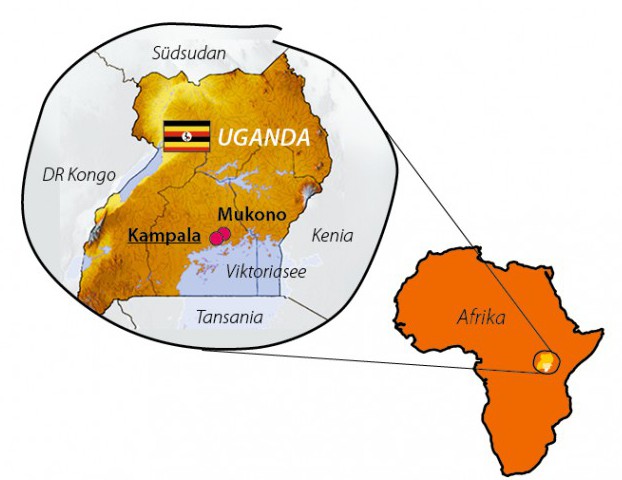
Uganda is a landlocked country in East Africa, bordering South Sudan to the north, Kenya to the east, Tanzania to the south, Rwanda to the southwest, and the Democratic Republic of the Congo to the west. Parts of the borders with Kenya and Tanzania run through Lake Victoria. (Source: Wikipedia)
Political and Social Situation
Uganda is still infamously remembered by many from the era of dictator Idi Amin. Since Yoweri Kaguta Museveni took power in January 1986, the country has continued to be governed authoritatively. Significant challenges remain, including restrictions on basic political rights, widespread corruption, and mismanagement. Fundamental rights anchored in the constitution are frequently undermined by political influence, the intimidation of civil rights activists and journalists, discrimination against sexual minorities, and traditional patriarchal structures.
Social and Economic Conditions
The majority of the population lives in rural areas and benefits only limitedly from steady economic growth. According to UNICEF (2022), over 21% of the population still lacks access to clean drinking water, and around 79% have no access to sanitary facilities. The child mortality rate stands at 4.05%. Additionally, Uganda continues to struggle with high HIV prevalence, despite being the first country in Africa to introduce medical measures against the virus.
The School System and Access to Education
A good education is a crucial foundation for a self-determined life, yet it is not available to all children free of charge. Help for a Smile is committed to securing school attendance through donations.
While school is compulsory for children under 15 and attending primary school is officially free, an education remains impossible for many because families must pay for school uniforms and materials themselves. In lower-cost schools, classes often have up to 80 students. Because many children must contribute to the family’s livelihood, only 41% are able to complete the seventh grade (Source: UNICEF, 2022).